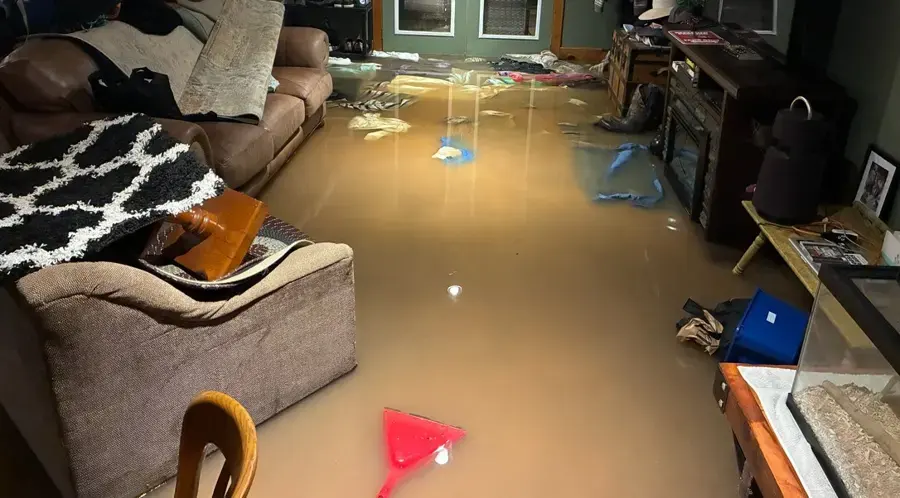
Murfreesboro sits on karst terrain, and the USGS studied 78 flooding sinkholes east, north and northwest of the city, most of them over Ridley Limestone.
Key takeaways
- A pan sinkhole floods when storm inflow fills a depression faster than the ground can drain it, so water can sit for a long time.
- Land changes that send more water into a depression can raise the flood height and make it last longer.
- Water that reaches a floor from a sinkhole or a creek is treated as contaminated, and porous materials are removed.
- Prompt pump out limits how far water wicks into drywall, cabinets and flooring.
- Drying continues until moisture readings match a dry reference, not until the surface looks dry.
What a flooding sinkhole is
Karst is limestone terrain where water dissolves rock and creates depressions, caves and drains. Murfreesboro is built on it, and the USGS has described the flooding of pan sinkholes there.
A pan sinkhole is a shallow depression that has no surface outlet. When storm runoff pours in faster than water can drain underground, the pan fills like a bathtub.
Where the ground drains slowly, the water can stand in a yard, a driveway or a low house for a long time after the rain has stopped.
- The USGS studied 78 flooding sinkholes east, north and northwest of the city, mostly over Ridley Limestone.
- A depression can be dry for months and then fill in one storm.
- Changes to land upstream of a depression can send more water into it.
How a pan fills and how deep it can get
Why a pan floods while the sky clears
A pan sinkhole behaves like a closed basin. Water arrives from the surrounding slope, but it leaves only through the rock and soil beneath it, which can be slow.
A creek flood peaks and falls. A sinkhole flood can plateau, sitting at the same level for a long stretch while the ground slowly takes it in.
That matters to a homeowner because water that sits against a house keeps soaking in. A wet exterior wall, a flooded garage or a low crawl space can stay wet until the water is pumped out.
- Creek floods rise and fall quickly; pan floods can linger.
- Standing water against walls pushes moisture into the framing.
- A garage or low room can hold water long after the rain ends.
The March 1975 flood on Johnson Street
In March 1975, sinkhole flooding damaged 12 homes on Johnson Street, with water nearly 7 feet deep on the first floor.
That depth shows how far a pan can rise. It also shows why a sinkhole flood is not just a wet carpet problem.
At that depth, walls, wiring, cabinets and every floor material have to be examined, and the drying plan covers the whole structure.
Most floods are far shallower than that. Even an inch of water on a floor can reach the subfloor under flooring and the bottom of every wall in the room.
Why drainage changes matter
Development and runoff
When land around a depression is graded, paved or built on, more runoff can reach it. The city and the USGS note that those changes can raise flood height and duration.
In July 2022, owners on Whittle Court reported driveway flooding of three to four inches after development behind their homes.
The December to April window
Murfreesboro's most critical flooding period is December to April, when the ground is wet and storms keep arriving.
A depression that is already full can hold a new storm's water on the surface, which is why pump out matters even when the rain has stopped.
What happens in a house when a sinkhole fills
Water enters through doors, garage openings, foundation gaps or low windows, and it spreads across the first floor. Baseboards and the bottom of drywall wick it upward, and cabinets and subfloors soak it up.
Flood water that comes from the ground and from storm runoff is not clean. It carries soil, debris and bacteria, so the cleanup treats it as contaminated and removes porous materials that cannot be cleaned.
- Carpet and pad are removed.
- Wet insulation and drywall below the high water mark are cut out.
- Hard surfaces are cleaned and treated.
- Furniture is moved or lifted off wet floors.
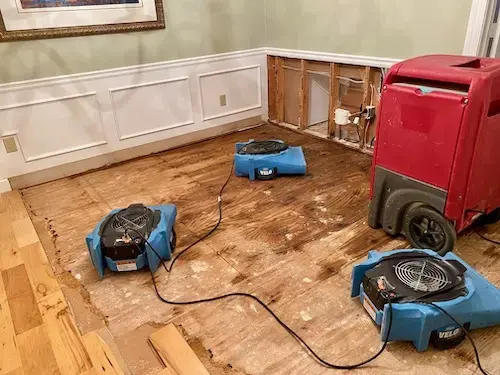
How pump out and drying work
The first visit is about stopping the spread. Before pumps run, the restoration team checks for hazards, shuts off power to wet circuits where needed and photographs the water level.
Standing water comes out first, with truck mounted or portable pumps depending on depth. Extraction goes before drying because every inch left behind gives water more time to soak into materials.
Once the water is gone, moisture meters map the wet zone and drying equipment is set. Air movers, dehumidifiers and drying mats run until readings match a dry reference.
The restoration team documents each step with photos and moisture logs for an insurance claim.
Rooms that were hit hardest are dried first, and barriers can keep dry rooms dry while the wet ones are being worked on.
- Extraction removes the water.
- Contaminated materials are taken out and bagged.
- Moisture mapping shows what can stay.
- Drying continues until readings are dry, not until the room looks dry.
What a homeowner can do before the water leaves
Do not walk through standing flood water; it may be contaminated and may hide hazards. Turn off the power at the breaker if it is safe to reach, and stay out of rooms where water is touching outlets.
Photograph the high water mark on the walls before it recedes, because that mark shows the depth for the claim.
Move valuables, papers and electronics to a higher floor if it is safe, and lift upholstered furniture onto blocks or counters.
Murfreesboro Water Resources runs a 24/7 emergency service for burst pipes, blocked sewer pipes and overflowing manholes, but it does not extract water from a house.
Related services in Murfreesboro and Smyrna
Flooding on karst terrain is not an uncommon event, and every loss starts with the same questions. How deep did the water get, how long did it sit, and what did it touch?
A clear answer to those questions shapes the cleanup. It tells the restoration team how much to remove, how to dry and how to document the loss.
A sinkhole flood calls for storm and flash flood cleanup and water extraction in the same visit, since pump out and drying belong together.
Homes near the Square, Old Fort Park and the Stones River Greenway share the same karst foundation, and the principles are the same across town.
Smyrna sits on the same karst and limestone terrain, so the restoration team handles storm flood cleanup there in the same way.
Questions
Why does water sit so long after a sinkhole floods?
A pan sinkhole drains only as fast as the ground below allows. If the depression is full, water can remain on the surface long after rain stops.
Is sinkhole flood water considered contaminated?
Yes. It carries soil, debris and bacteria, so porous materials are removed and hard surfaces are cleaned and treated.
Which months bring the most flood risk in Murfreesboro?
December to April is the most critical flooding period, though a heavy storm can fill a depression at any time.
Does the city pump water out of a flooded home?
No. The city's emergency service handles public pipes, sewers and hydrants, while the restoration team extracts water from the house.
Can a house in a low spot be protected before a storm?
Moving valuables up, clearing drains and gutters, and knowing where the breaker panel is can help. A pan sinkhole can still fill, so the cleanup plan matters.
How is the structure dried after the water is out?
Air movers, dehumidifiers and drying mats run until moisture readings match a dry reference material.