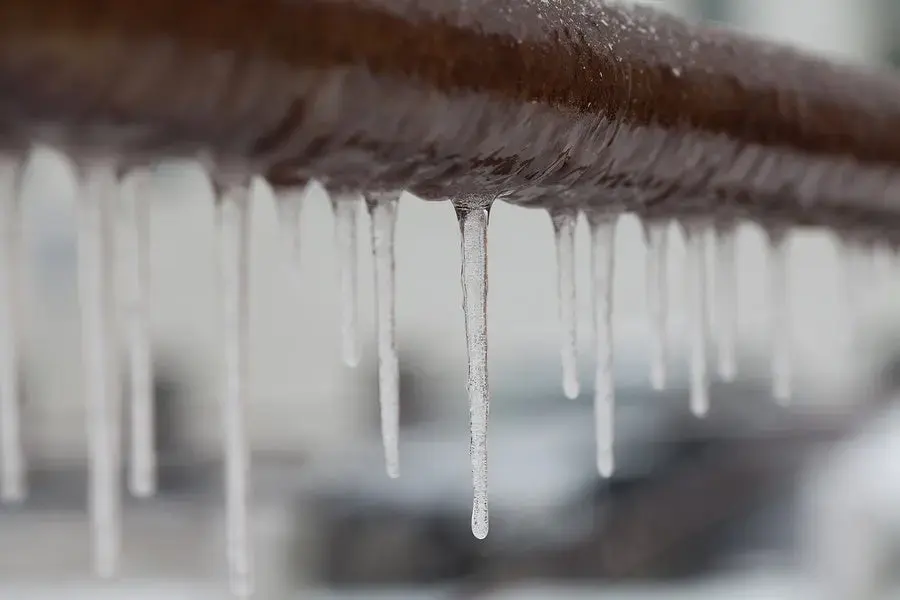
From January 24 to 27, 2026, a winter storm dropped three days of snow, ice and freezing rain on the Murfreesboro area, and schools across Rutherford County closed.
Key takeaways
- A frozen pipe often splits quietly, and the water only runs when the ice melts, which can be days after the freeze itself.
- The usual trouble spots in Smyrna homes are attics, exterior walls and crawl space pipes.
- Shutting off the main supply at the first sign of a thaw leak limits how much water gets into insulation and drywall.
- Wall cavities are opened only where moisture readings show water, not everywhere a stain appears.
- Insulation that has soaked up water is removed, and the framing is dried to a reading before anything is closed up.
What the January 2026 storm did to pipes
The January 24 to 27, 2026 storm brought three days of snow, ice and freezing rain to Murfreesboro, and Murfreesboro and Rutherford County schools closed on Monday and Tuesday.
Smyrna sits in the same county and has the same climate, with humid subtropical weather and an occasional hard freeze that tests every pipe in an outside wall or an attic.
Most Smyrna homes date from the 1990s on. That is old enough for pipes to run through attics and exterior walls where cold air can reach them, and new enough that homeowners may never have seen a pipe break.
- Ice does not usually crack a pipe where the ice sits; pressure builds between the ice and a closed faucet, and the pipe splits at its weakest point.
- The split often stays sealed by ice until a thaw begins.
- The damage shows up when the temperature rises, not when it drops.
Where pipes split in Smyrna homes
Attics
Supply pipes in an attic are exposed to the coldest air in the house. When one splits, water soaks the insulation first, then drips through the ceiling below.
Ceiling stains, a sagging patch of drywall or a drip from a light fixture are signs of an attic problem.
Exterior walls
Kitchen and bathroom walls that face the outside can hold a supply pipe close to cold sheathing. A split inside the wall may run for a long time with nothing visible except a damp baseboard or a soft spot in the drywall.
Cabinets under a sink on an exterior wall are another common spot, because the pipe sits near the cold wall behind them.
Crawl spaces
Homes on a vented crawl space let winter air under the floor. Supply pipes and some drains below the floor can freeze, and the leak soaks the vapor barrier, joists and subfloor.
What to do when a pipe thaws and leaks
First steps at the first leak
Shut off the main water supply to the house first. Locate the shutoff before the next freeze, because a thawing pipe does not give notice.
Turn off the power to any room where water is dripping through light fixtures or ceiling fans, and keep people out of the area until it is safe.
- Close the main shutoff and open a low faucet to drain the system.
- Move furniture, electronics and rugs away from wet areas.
- Photograph the damage, the split pipe and the water before anything is moved.
- Call a plumber for the pipe and the restoration team for the water.
Signs that a pipe has already split
Some splits announce themselves with a rush of water. Many do not, especially when the pipe is inside a wall or above a ceiling.
A homeowner who sees any of the following after a hard freeze should check the main shutoff and look for water before assuming the house is fine.
- A water meter that keeps moving when every tap and appliance is off.
- Low water pressure or a faucet that runs weakly after the thaw.
- A damp, cold or discolored patch on a ceiling or an exterior wall.
- The sound of dripping or running water in an attic or wall.
- A musty smell near a vanity cabinet on an outside wall.
How the restoration team handles a thaw leak
Extraction, removal and drying
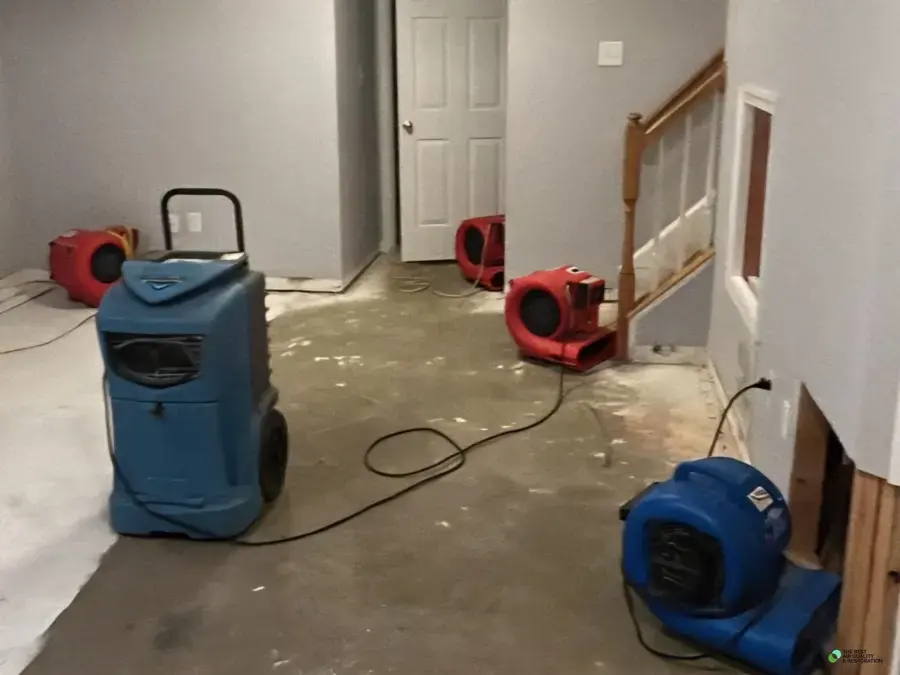
Standing water is extracted first, and wet insulation is removed from the attic or crawl space. Insulation holds water against framing and drywall, so it is not left in place.
Moisture meters then map the wet zone, and wall cavities are opened only where readings show water. A stain on the outside of a wall can be much smaller than the wet area behind it.
Air movers and dehumidifiers run until the framing, subfloor and drywall read within 2 to 4 points of a dry reference material.
- Extraction removes the standing water.
- Wet insulation and ruined drywall are taken out.
- Moisture mapping decides how far the opening goes.
- Drying equipment stays until readings, not the calendar, say the structure is dry.
Why the wet area is larger than the stain
Water follows gravity and framing, not a straight path. A split in an attic pipe can soak insulation across several joist bays, then show up as one ceiling stain in a bedroom below.
Inside a wall, water runs down the cavity and settles at the bottom plate and the baseboard. Drywall wicks that water upward, so a wall that looks fine at eye level may be wet near the floor.
That is why the restoration team reads the wall with a meter before cutting. Opening more than the readings call for adds cost and disruption, and opening less leaves wet material behind.
Murfreesboro homes and the city's emergency service
Murfreesboro Water Resources runs a 24/7 emergency service for burst water pipes, blocked sewer pipes, overflowing manholes and damaged fire hydrants.
That service covers the public side of the system. A split pipe inside a house is the owner's problem, which is why a plumber and the restoration team are usually the next calls after the shutoff.
For homes in Murfreesboro, the process is the same: stop the water, find the split, dry what got wet.
Protecting pipes and documenting a freeze loss
Protecting pipes before the next hard freeze
Insulation, closed foundation vents and cabinet doors left open on cold nights lower the risk. A faucet left dripping on a very cold night keeps water moving, though a drip is no promise that a pipe will survive.
A homeowner who knows where the main shutoff sits can act at the first sign of a leak, which is the best protection against a large loss.
- Know where the main shutoff is and that it turns.
- Open cabinet doors on exterior walls during a hard freeze.
- Close crawl space vents and insulate exposed pipes before winter.
- Look in the attic after a freeze for wet insulation.
Documenting a freeze loss for insurance
A thaw leak is often a covered loss, and the claim goes better when the record is clear. Photographs of the split pipe, the wet materials and the shutoff valve all help.
The restoration team keeps moisture readings, equipment logs and photos from the dry out, and those records support the claim.
- Take photos before moving anything.
- Keep the split section of pipe if the plumber removes it.
- Save receipts for the plumber and for any temporary repairs.
- Ask for the moisture log at the end of drying.
Related services in Smyrna
A split pipe in an attic or wall often needs both frozen pipe cleanup and burst pipe water damage work, because the freeze and the flood are two stages of the same loss.
Questions
Why does a frozen pipe leak after the freeze ends?
Ice can plug a split. When the temperature rises and the ice melts, water flows through the crack.
Should the water be turned off right away?
Yes. Closing the main shutoff stops the flow while a plumber finds the split.
Does a stain on a ceiling mean the whole ceiling is wet?
Not always, but it often means water has traveled further than the stain shows. Moisture readings show the true extent.
Can wet insulation be left to dry?
Usually not. Wet insulation holds water against framing and drywall, so it is removed and replaced.
Who handles a burst pipe inside a Murfreesboro home?
The city service covers public pipes. A plumber repairs the pipe in the house, and the restoration team dries the damage.