Structural Drying and Dehumidification in La Vergne, TN
A room can feel dry in a day while framing, subfloor and concrete still hold water. The drying team plans equipment around the class of loss and leaves it running until moisture readings agree with a dry reference material.
(888) 849-5796La Vergne framing dried out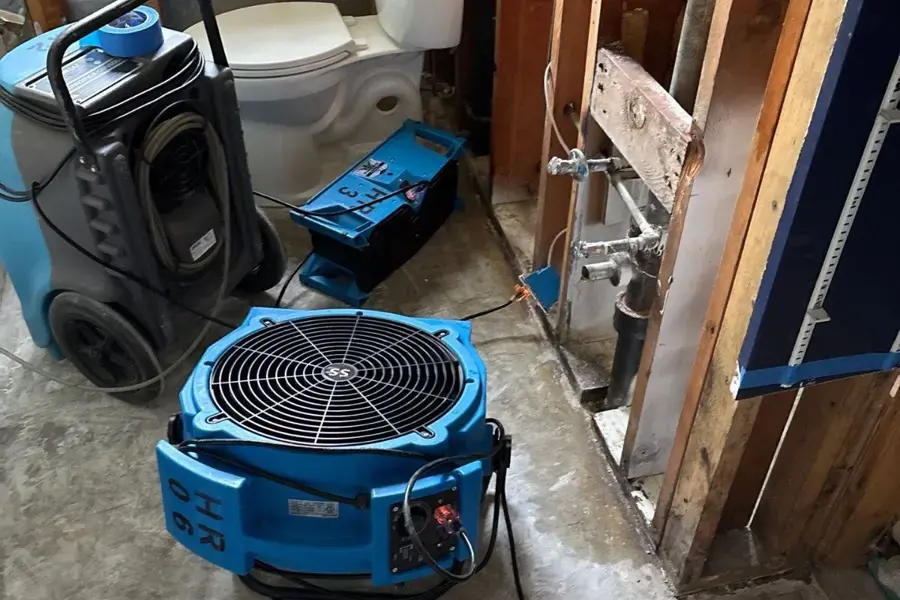
Drying is the part of a water loss that nobody sees, and La Vergne's humid subtropical air makes it harder. Wet materials release water slowly when the air is already damp, and limestone-based karst ground under Rutherford County holds water too, so extended dehumidifier drying is often needed.
First steps for structural drying and dehumidification in La Vergne
- 1
Stop the leak
Equipment cannot do its job while water is still entering.
- 2
Remove standing water
Extraction always comes before drying equipment.
- 3
Keep windows shut
Muggy outside air works against the equipment, so keep windows closed.
- 4
Leave it running
Equipment that stops overnight lets humidity climb back.
What does structural drying and dehumidification cost in La Vergne, TN?
Structural drying in La Vergne, TN usually costs $1,000 to $10,000, depending on the class of loss, how many rooms are involved, the materials and how many days of equipment and monitoring the readings require.
Class 1 or 2, a single area
$1,000 to $3,000
- Fans on the floor
- LGR dehumidifier
- Checks every day
Class 3 across several rooms
$3,000 to $6,500
- Cavity drying
- Extra equipment
- Humidity logs
Class 4, concrete or wood floors
$6,500 to $10,000
- Desiccant units and mats
- Longer monitoring
- Complete documentation
Ranges are typical, not a quote: category of water, square footage, material class and how fast drying started move the number most. Run the water damage cost calculator for a closer range.
How structural drying and dehumidification is handled in La Vergne
The tech who does the walkthrough maps moisture before any equipment goes down, so the drying plan matches what is actually wet. Equipment stays until the readings say dry, not until it looks dry.
- 01
Rate the loss
Water category and loss class shape the equipment plan room by room.
- 02
Place equipment
Air movers and dehumidifiers are sized to the evaporation load.
- 03
Log each day
Temperature, humidity and material readings are recorded daily.
- 04
Reach the goal
Equipment leaves only after materials reach the dry reference.
Equipment follows the class of loss
IICRC S500 is the standard that links equipment to the loss. Class 1 is a small, low-porosity loss, Class 2 covers a room of carpet and wall bottoms, Class 3 is water from overhead soaking walls high, and Class 4 involves dense materials like hardwood, plaster and concrete. That class sets the number of air movers and the dehumidifier size for each room.
- Air movers sized to each room's evaporation load.
- LGR units for most losses, desiccant units for Class 4 or cooler air.
- Temperature and humidity logged every day.
Dry is a number
The goal is a figure, not a feeling. The crew compares readings on wet materials with the same materials in a dry part of the house and stops when they sit within 2 to 4 points. Daily logs go into the claim file. Slabs are covered at slab leak water damage and wood floors at hardwood floor water damage.
Hot, humid summers slow the work
La Vergne summers are hot and humid, which leaves little room in the air for evaporation. Dehumidification keeps the air dry enough to pull water from wet materials, and windows stay shut so outdoor moisture does not undo the progress. The drying time estimator gives a typical window.
Structural drying and dehumidification across La Vergne and nearby towns
The La Vergne drying team covers ZIP 37086, from Lake Forest Estates and Akin Heights to Driftwood Village, Stonehenge and the neighborhoods along Bill Stewart Blvd.
The same service nearby: structural drying and dehumidification in Smyrna, Nolensville, Brentwood.
Related water damage services in La Vergne
Structural Drying and Dehumidification questions in La Vergne, TN
Why does equipment stay once the floor feels dry?
Framing, subfloor, drywall and slabs keep water inside long after surfaces dry. Readings, not touch, decide when drying is finished.
What does an LGR dehumidifier do?
A low grain refrigerant unit removes more water from the air than a household dehumidifier, even when the air is already fairly dry.
When do desiccant units come in?
For Class 4 materials such as hardwood, plaster and concrete, and in cooler air where refrigerant units lose efficiency.
Does karst ground affect drying?
Rutherford County sits on karst terrain with limestone bedrock, and that ground holds water. It is one reason longer dehumidifier runs are common here.
Should I turn the equipment off at night?
Better not to. Drying is continuous, and a pause lets humidity rise again.
Why do the logs matter?
They show the adjuster the structure reached its goal and support the number of equipment days.
Walls or floors still damp in La Vergne? Start the dry-out.
Moisture trapped in framing, subfloor and concrete keeps causing damage until the numbers say it is dry.
Smyrna, TN · Rutherford County · open 24/7