Structural Drying and Dehumidification in Murfreesboro, TN
Surface-dry is not dry. The crew matches machines to how wet the structure is, dries framing, subfloor and walls and records moisture readings daily until they agree with a dry reference.
(888) 849-5796Dry the structure right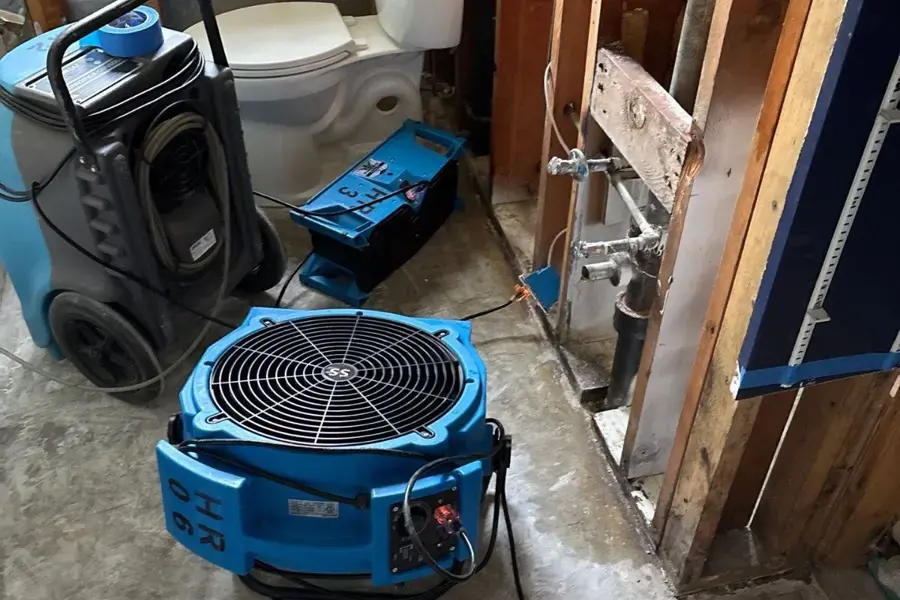
In March 1975, sinkhole flooding put nearly 7 feet of water on the first floor of homes on Johnson Street. When water reaches that height, walls, floors and framing all need full drying, and the depth shows how far water can climb inside a house.
First steps for structural drying and dehumidification in Murfreesboro
- 1
Stop the source
Dry equipment cannot work while water is still entering.
- 2
Remove standing water
Extraction comes first, because it is faster than evaporation.
- 3
Keep windows shut
Outside humid air works against the dehumidifiers.
- 4
Leave machines running
Equipment stays until the readings say it is done.
What does structural drying and dehumidification cost in Murfreesboro, TN?
In Murfreesboro, TN, structural drying typically costs $1,000 to $10,000, depending on the class of loss, the number of rooms, the materials involved and the days of monitoring needed.
Class 1 or 2, one area
$1,000 to $3,000
- Air movers placed
- Refrigerant dehumidifier
- Readings each day
Class 3, several rooms
$3,000 to $6,500
- Cavity drying
- Added equipment
- Humidity and temperature logs
Class 4, concrete or wood
$6,500 to $10,000
- Desiccants and mats
- Extended monitoring
- Complete claim record
Ranges are typical, not a quote: category of water, square footage, material class and how fast drying started move the number most. Run the water damage cost calculator for a closer range.
How structural drying and dehumidification is handled in Murfreesboro
The tech who does the walkthrough maps moisture before any equipment goes down, so the drying plan matches what is actually wet. Equipment stays until the readings say dry, not until it looks dry.
- 01
Classify the loss
The class and category set how much equipment is needed.
- 02
Place the equipment
Air movers and dehumidifiers are set according to the calculation.
- 03
Check daily
Meters and psychrometric readings track progress.
- 04
Reach the goal
Equipment leaves when materials match a dry reference.
Drying is a calculation
Equipment is chosen from the volume of the room, the class of loss and the materials involved. Too little air movement leaves pockets of dampness, while too much wastes energy and can over-dry the wood. The count is figured before anything is plugged in.
- Class 1 and 2: smaller wet areas
- Class 3: wet from above
- Class 4: dense materials like concrete
How dry is dry
Moisture meters check studs, plates and subfloor against a reference reading from an unaffected area. Thermal imaging finds wet spots meters might miss. Daily readings are logged, and the equipment stays until the numbers agree. The same method follows water extraction on any job.
Why humidity needs managing
Dehumidifiers pull water vapor out of the air, which allows wet framing to release moisture. Without them, fans only move damp air around. On concrete and thick wood, desiccant units reach what a refrigerant dehumidifier cannot.
Floors, walls and framing do not dry at the same rate, so equipment is moved as readings change. Wood framing near the source often takes longer than drywall, and concrete takes longer than both. A leak under a concrete floor is a good example, covered under slab leak water damage.
Placing equipment well matters as much as the count, since air that cannot reach a wet wall cavity does nothing for it.
Structural drying and dehumidification across Murfreesboro and nearby towns
Structural drying covers ZIPs 37127, 37128 and 37129, from Riverview Park and Evergreen Farms to Johnson Street, Hidden River Estates and neighborhoods near Cason Lane.
The same service nearby: structural drying and dehumidification in Smyrna, La Vergne, Nolensville.
Water damage restoration in Murfreesboro · every town covered
Related water damage services in Murfreesboro
Structural Drying and Dehumidification questions in Murfreesboro, TN
Why do machines keep running when surfaces feel dry?
Framing and subfloor hold moisture longer than surfaces do. Machines stay until the numbers match an unaffected sample.
How many days will drying take?
Three to seven days is typical for a contained loss, while concrete, hardwood and multi-room floods run longer.
What does Class 4 mean?
It marks dense materials such as concrete or hardwood that absorb water slowly and release it slowly, so extra equipment is used.
Is the noise normal?
Yes. Air movers and dehumidifiers run all day and night, and the sound drops once the structure is drier.
Does insurance pay for drying?
The drying that follows a covered loss is commonly included. Your insurer decides, so keep the readings and logs.
Will the equipment raise the power bill?
Dehumidifiers and air movers draw electricity, so the bill can climb during a dry-out. A shorter drying time keeps the increase small.
Drying a Murfreesboro structure? Get it dried right.
Moisture left in framing and subfloor keeps causing damage until readings reach a dry reference.
Smyrna, TN · Rutherford County · open 24/7